
 English
 Português
 Español

A purchase order for brake components rarely fails on price. It fails on fitment, on friction behaviour that does not match the original unit, or on a caliper that starts weeping fluid halfway through its first season. Distributors who treat automotive disc brakes as a system — pad compound, rotor condition, caliper design, master cylinder bore and fluid quality working together — see far fewer returns than those who buy part numbers in isolation.
The disc brake itself is a straightforward energy converter: the vehicle's motion becomes heat at the pad-to-rotor interface, and the hydraulic circuit exists purely to generate and modulate the clamping force that creates that heat. Understand that chain and most sourcing decisions become easier, because every specification you ask a supplier for can be traced back to a physical function.
How Automotive Disc Brakes Turn Pedal Force into Stopping Power
When the driver presses the pedal, a vacuum or electric booster multiplies leg effort, and the master cylinder converts that force into hydraulic pressure. Because the caliper piston area is larger than the master cylinder bore, the same pressure acting on a bigger surface produces a much greater clamping force — the principle Pascal described, and the reason a modest pedal push can stop a two-tonne vehicle.
Under hard application, line pressure in a passenger car can climb well past 50 bar. That pressure pushes one or more pistons outward, the piston moves the inner pad, and the reaction force pulls the caliper body or bracket so the outer pad contacts the opposite face of the rotor. Two friction surfaces clamp one rotating disc, kinetic energy becomes heat, and the vented rotor and airflow carry that heat away.
Two consequences follow. First, pad surface temperatures of 300–400 °C are routine in repeated hard stops, so every material in the assembly — friction compound, backing plate, piston, seal, boot and fluid — must tolerate heat. Second, any air in the hydraulic circuit is compressible and will convert pedal travel into nothing useful, which is why bleeding procedures exist and why a soft pedal is a hydraulic fault rather than a pad fault.
Core Components and What Each One Does
Most aftermarket returns trace back to one component being specified correctly but matched incorrectly against its neighbours. The table below maps function to the failure mode buyers actually see in the field.
| Component | Function in the system | Typical wear or failure | Sourcing check |
|---|---|---|---|
| Brake pad | Generates friction against the rotor face | Friction material thinning, taper wear, noise, fade when hot | Friction classification, shear strength, shim and chamfer design |
| Brake caliper | Holds the pads and converts hydraulic pressure into clamping force | Seized piston, torn dust boot, corroded guide pins, fluid leak | Bore finish, piston material, boot compound, slide function |
| Master cylinder | Creates hydraulic pressure from pedal input | Internal seal bypass causing a sinking pedal, external leak | Bore diameter, reservoir fitment, port configuration |
| Brake hose and line | Carries fluid to each corner | Internal collapse, cracking at the crimp | Pressure rating, fittings, hose age on shelf |
| Brake fluid | Transmits pressure and absorbs moisture | Moisture uptake lowers boiling point; vapour lock under load | DOT specification, sealed packaging, shelf-life control |
Pad Compounds: Ceramic, Semi-Metallic and High-Carbon
Friction materials are not normally defined by a single coefficient of friction, because that value shifts with temperature, pressure and speed. What matters commercially is how stable the compound stays across the working range, how much dust and noise it produces, and how it treats the rotor.
Semi-metallic formulations use steel fibre and metal powders for heat transfer and high-temperature stability, which suits heavier vehicles and hotter duty cycles but generates more dust and rotor wear. Ceramic formulations use ceramic fibres and fillers to deliver quieter operation, lighter dust and stable cold performance, making them a strong fit for passenger car aftermarket programmes. Non-asbestos organic compounds sit between the two on cost and comfort.
Two purchasing details separate a reliable pad programme from a problematic one. The backing plate must be treated for corrosion at the edges, and the shim must be bonded rather than loosely fitted, because shim rattle is often misdiagnosed as a pad quality problem. Buyers selling into California or Washington also need to confirm copper content, since both states have phased down copper in brake pads toward a 0.5% limit. A supplier who can document compound composition per reference number removes a recurring compliance headache.
For a closer look at how these families behave in service, this comparison of ceramic, semi-metallic and organic friction materials covers noise, dust and rotor wear in more detail.
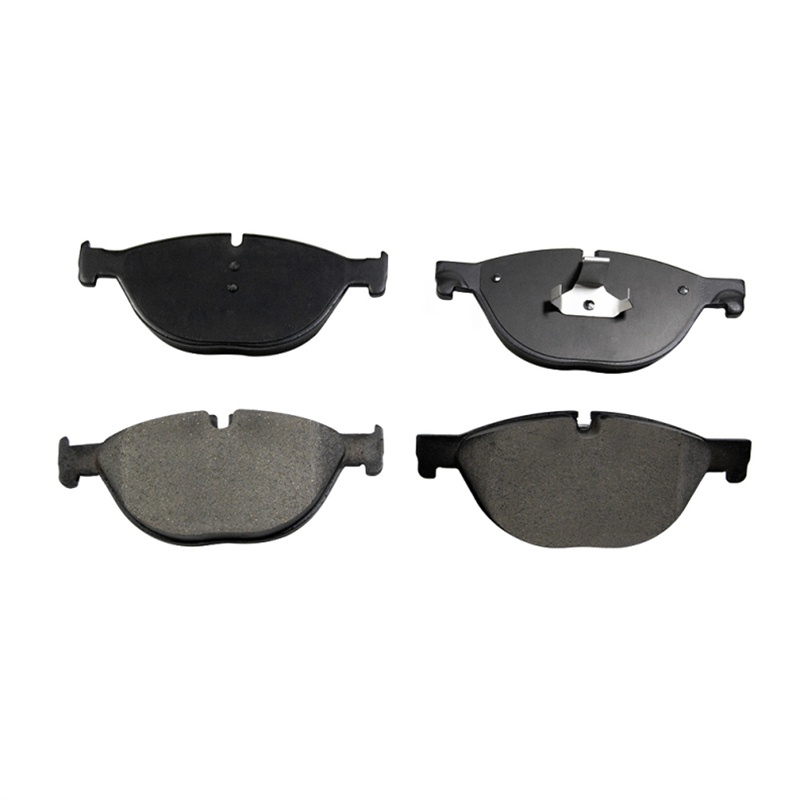 Ceramic Brake Pads for BMW ApplicationsCeramic brake pads for BMW applications, identified by OE numbers 34116851269, 34116775318 and 34116775322, for routine replacement where the specified friction type matches.View Product →
When a single platform is offered in both ceramic and semi-metallic versions, keep the two reference numbers separate in your catalogue. Applications that specify ceramic from the factory should not be substituted with semi-metallic purely to hit a price point, because the change alters pedal feel and dust behaviour that the end customer will notice.
Calipers: Floating and Fixed Designs, and Rebuild Economics
Floating calipers use one or two pistons on the inboard side and slide on guide pins so the outboard pad is pulled into contact by reaction force. They dominate volume passenger cars because they are light and inexpensive. Fixed calipers carry opposed pistons on both sides of the rotor, give more even pad loading and better heat capacity, and appear on performance and heavier applications.
Rebuild quality is where caliper sourcing is won or lost. Check the piston material — phenolic pistons resist heat transfer to the fluid better than steel, while plated steel pistons tolerate rougher environments. Check the dust boot compound, which should be an EPDM rubber that survives brake fluid exposure and ozone. Check that the guide pins carry a high-temperature silicone grease rather than a general-purpose lubricant, and that the bleed screw seat is machined cleanly, because a weeping bleeder is a common cause of comeback complaints.
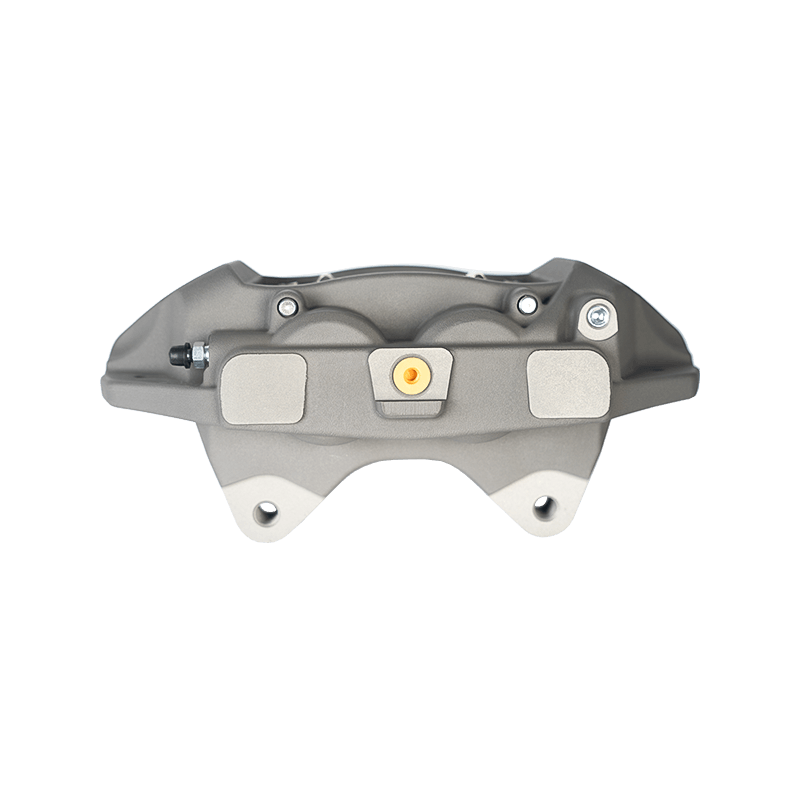 Automobile Brake Caliper for Wholesale SupplyAutomobile brake caliper presented as a wholesale catalog item, with model and application details available on inquiry and OEM/ODM support indicated.View Product →
Rear calipers with an integrated electric parking brake add a gear reduction stage and a motor interface. These are far less tolerant of remanufacturing shortcuts, since the ball-screw or gear mechanism must be reset correctly, and a caliper that cannot retract properly will destroy a new set of pads within months.
Master Cylinders and Pedal Feel
The master cylinder sets the hydraulic character of the whole vehicle. A larger bore moves more fluid for a given pedal stroke but produces lower pressure, giving a firmer, shorter pedal; a smaller bore increases pressure and pedal travel. Substituting a different bore size to solve a stock shortage changes braking balance and should never be treated as a minor variation.
Reservoir shape, outlet port angles, switch threads and pushrod depth all vary by platform, so an OEM cross-reference alone is not sufficient confirmation. Ask for a dimensional drawing showing bore diameter, flange bolt spacing, port orientation and overall length, then compare it against the original part. On the production side, honing finish inside the bore and the grade of the primary and secondary cup seals determine whether the unit holds pressure after thousands of cycles.
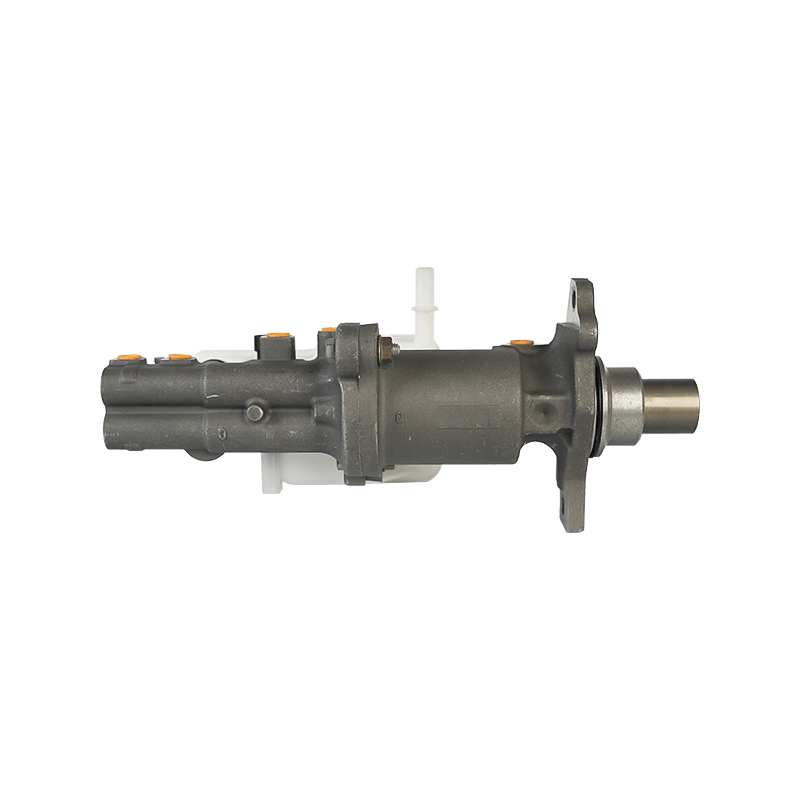 Brake Master Cylinder for Chevrolet and CadillacOE-spec 20759706 brake master cylinder with dual-bore aluminum body for listed Chevrolet, Cadillac and GMC SUV and pickup applications, intended for direct-fit replacement.View Product →
Every replacement master cylinder needs bench bleeding before installation. Trapped air in the bore cannot be pushed out through the proportioning valve once the unit is on the vehicle, and installers who skip this step frequently blame the part for a spongy pedal.
Quality Verification Before You Commit to a Purchase Order
Brake components are safety parts, so approvals and inspection records are not paperwork formalities. In Europe, replacement pads and discs are covered by UN Regulation No. 90, which requires aftermarket friction parts to demonstrate performance comparable to the original. In the United States, FMVSS 135 defines the vehicle-level braking performance requirements that aftermarket parts must not undermine.
- Dimensional report per production lot: bore diameter, piston outside diameter, mounting hole pitch, offset and thread pitch, measured with a coordinate measuring machine or air gauge.
- Hydrostatic hold test on calipers and master cylinders at a multiple of working pressure, with no measurable drop over the hold period.
- Salt spray testing to ASTM B117 on plated bodies and pistons, with the hours stated in the report rather than implied.
- Pad shear strength testing to ISO 6312, plus compressibility data to ISO 6310 where the customer specifies it.
- Valid IATF 16949 and ISO 9001 certificates with a verifiable audit date and certification body.
- UN R90 approval documents linked to specific pad reference numbers, not to a product family in general.
Sample evaluation should include an installation trial on a real vehicle where possible. A caliper that fits a bracket but binds on the pad abutment clips will pass every dimensional check and still generate a warranty claim.
Preparing a Brief for Custom Manufacturing
Buyers moving from catalogue purchasing to private label need to supply more than a part number. A useful brief includes the OEM reference and all known interchangeable numbers, the full vehicle application list with year and engine variants, expected annual volume per reference, packaging and labelling artwork, and the market the product is destined for, since approval requirements differ between regions.
From there, a manufacturer can confirm tooling availability, propose the friction compound or piston material, and advise on shim and chamfer design. Where a platform is not yet covered, ODM development starts with a sample or a technical drawing and proceeds through dimensional verification, laboratory testing and road evaluation. Realistic lead times depend on whether tooling exists, so a supplier quoting a firm date before seeing drawings is guessing.
Yancheng Yanitiger Auto Parts has supplied brake and clutch components to the global aftermarket since 1998, with a hydraulic range of more than 7,000 references and over 1,000 brake shoe and pad items covering European, American, Russian, Japanese and Korean vehicles. The wider brake system components catalogue is organised by assembly type, which makes cross-referencing easier when you are building a new range.
Frequently Asked Questions
Q1. What is the practical difference between a floating and a fixed caliper?
A floating caliper has pistons on one side only and slides on guide pins to clamp the rotor, so it is lighter and cheaper. A fixed caliper uses opposed pistons and gives more even pad loading plus greater heat capacity, which is why it appears on performance and heavy-duty applications.
Q2. How do I decide between ceramic and semi-metallic pads for my market?
Match the original specification first. Ceramic suits passenger cars where low dust and quiet operation matter; semi-metallic suits heavier vehicles and hotter duty cycles. Changing the family changes pedal feel and dust behaviour, so treat it as an engineering decision rather than a cost decision.
Q3. What does ECE R90 approval actually cover?
UN Regulation No. 90 covers replacement brake lining assemblies, drum brake linings, discs and drums for specified vehicle categories, and requires aftermarket friction parts to show performance comparable to the original. Approval is issued per reference number, so ask for the document tied to the exact part you are buying.
Q4. Why does a new master cylinder need bench bleeding?
Air trapped inside the bore and behind the seals cannot easily pass through the proportioning valve once the unit is installed. Bench bleeding removes it before fitting, which prevents a spongy pedal that is often wrongly attributed to a defective part.
Q5. How is brake pad shear strength tested?
ISO 6312 defines the shear test procedure for disc brake pad assemblies, measuring the force needed to separate the friction material from the backing plate. It is one of the clearest indicators of bonding quality and is worth requesting as lot-level data.
Q6. What are typical MOQ and lead times for private-label brake parts?
Both depend on whether tooling and compound already exist for the reference, the packaging requirement and the order mix across part numbers. Confirm quantities and schedules against your specific range rather than assuming a standard figure, since mixed container loads are quoted individually.
If you are building or expanding a disc brake range, send your OEM reference list, target markets and volume estimate to the manufacturer for a specification review. Confirming fitment data, friction compound and approval documentation before the first order is far cheaper than correcting a container after it lands.